


Celine Zabout Is Building an Aviation Training Platform Around Understanding, Not Shortcuts

Aug. 25 2026, Updated 4:21 p.m. ET


My Flight Academy brings online ground school, instructor tools, student tracking, and a flipped-classroom approach into one system designed to make training more connected without replacing real instruction.
Aviation students have more digital tools than ever. They can watch lessons, take quizzes, search regulations, review videos, join forums, and find explanations within minutes. Celine Zabout sees the value in that access, but she also sees the risk.
More content does not always create better pilots.
Zabout is the founder and CEO of My Flight Academy LLC, an aeronautical knowledge curriculum designer, commercial pilot, and FAA flight and ground instructor. Her work sits at the intersection of aviation education, curriculum design, online learning, and instructor support. She is building a training platform around a belief that sounds simple, but often gets lost in digital education: technology should help students learn more deeply, not just move through content faster.
“Technology should not replace instruction,” Zabout says. “It should make instruction more focused, more useful, and more connected to what the student actually needs.”
That belief shaped My Flight Academy from the beginning. Many aviation programs solve one part of the training process. Some offer videos. Some focus on test preparation. Some manage student records. Zabout wanted something more connected, a system where self-study, instructor guidance, progress tracking, and flight preparation could support one another instead of sitting in separate places.
Her focus is not only on what students study. It is how their preparation shows up later, when they sit with an instructor or step into the airplane.
“Access to information is not the same as understanding,” she says. “In aviation, that difference matters.”
My Flight Academy’s VFR course gives students organized ground training with video lessons, slides, FAA-based reading assignments, audio options, quizzes, resource materials, and written test preparation. The platform also includes a Student Console with progress tracking, notes, instructor connection tools, and lifetime access so students can return to the material as their training continues.

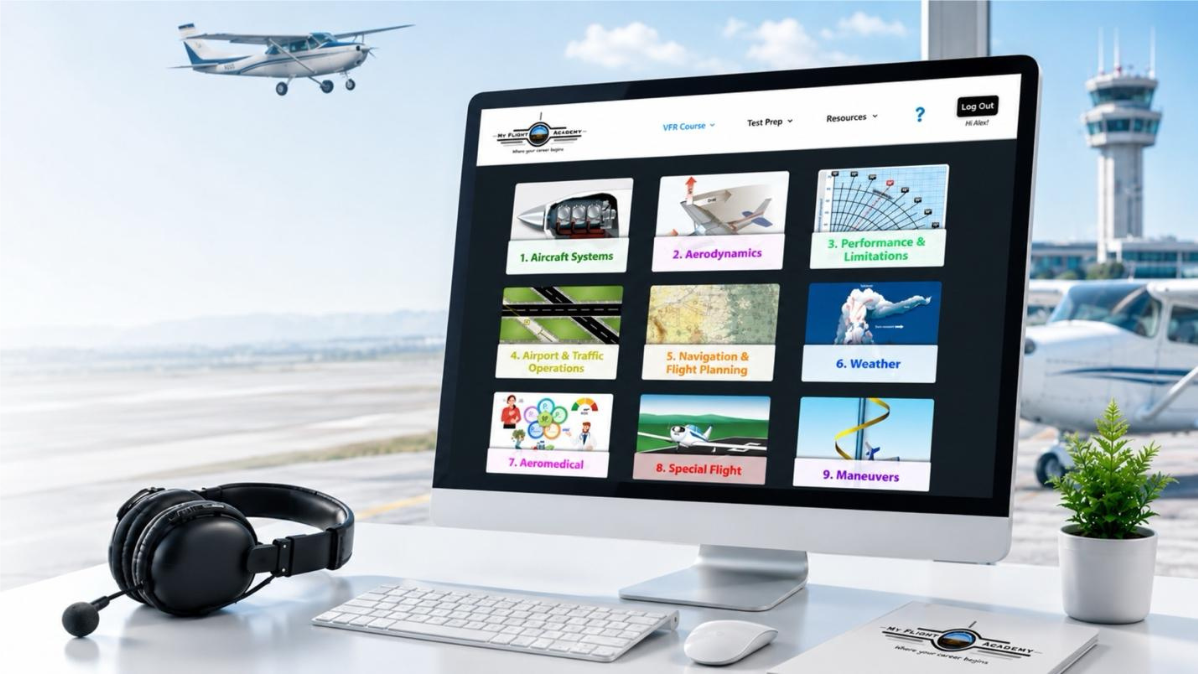
The details matter because Zabout is not trying to create another digital library. She is building the course around a learning process. A student should be able to prepare, review, notice gaps, connect with an instructor, and keep moving through training with a clearer sense of where each piece belongs.
That is where the instructor side becomes important. My Flight Academy includes tools for instructors and schools, including internal chat and student progress tracking, with a syllabus creator planned for release. Zabout wants these tools to help instructors and schools organize pilot training efficiently and clearly by providing a comprehensive view of what students have completed, where they may need support, how ground and flight training connect, and the next steps in their training.
“Instructors should know where a student is struggling, but it’s not always obvious,” Zabout says. “If the platform can help point that out, the instructor can address weak areas more effectively.”
Her approach draws from flipped-classroom learning, but she is applying it in a practical aviation training context. Students prepare before meeting with an instructor. The platform gives that preparation structure. The instructor can then use the session for discussion, clarification, scenarios, student participation, and application.
In that model, online learning is not the lesson’s endpoint. It is the starting point for better instruction.
“I wanted students to arrive with something to build on,” Zabout says. “Then the instructor can spend more time asking questions, working through decisions, and helping the student apply what they studied.”
That distinction matters because aviation training is not only about completing modules or passing exams. Ground knowledge affects flight planning, weather decisions, aircraft performance, airspace awareness, regulations, and risk management. If students move through those topics passively, they may not build the kind of understanding that supports safe decisions later.
Zabout’s own training experience helped her see the problem, but My Flight Academy is not built only from personal frustration. As an instructor, she saw students who had studied but still needed help organizing what they knew. As a curriculum designer, she wanted the learning sequence to feel more deliberate. As a platform builder, she wanted the technology to support the relationship between the student and instructor rather than replace it.
“I kept coming back to the same idea,” she says. “Students need structure, but they also need interaction. A course alone is not enough if the student never learns how to use the knowledge.”
Her academic background also shaped the platform. Zabout studied areas related to sociology, languages, and societies, which influenced how she thinks about communication, learning behavior, and the way students absorb information. Aviation may be technical, but students still learn like human beings. They have different habits, attention spans, levels of confidence, and ways of processing material.
That is one reason My Flight Academy uses several formats. Video can explain a concept visually. Reading can slow the student down. Audio can give students another way to engage with the material. Quizzes can test understanding and reveal weak areas. Notes and progress tracking can help the student stay organized. Instructor tools can bring the live teacher back into the process.
“Videos can be useful, but they are not the whole answer,” Zabout says. “Reading still matters. Discussion still matters. Students need time to process, not just consume.”
Building the platform required Zabout to move far beyond aviation instruction. She built much of the foundation herself, learning course design, website development, user experience, automation, and the technical side of an online education platform. She also co-owns an auto repair shop, so business ownership was not unfamiliar, but My Flight Academy required a different mix of skills.
She had to think like a pilot, teacher, student, designer, and builder at the same time.
That mix gives the platform its shape. It is not only a course for students. It is also a system designed to support instructors and flight schools as training becomes more digital. Zabout believes modernization should not mean adding tools just because the tools exist. It should mean giving students and instructors a better way to work together.
Never Miss an

Daily updates from the heart of Hollywood, right to your inbox
By entering your email and clicking Sign Up, you’re agreeing to let us send you customized marketing messages about us and our advertising partners. You are also agreeing to our Terms of Service and Privacy Policy.


“Modernizing training should not mean leaving students alone with more content,” she says. “It should mean giving them a clearer structure and stronger support through better communication with instructors.”
The platform is still expanding, with additional TMS tools and features, including scheduling. The IFR course is in development. Future courses may include multi-engine, CFI, and ATP training. Zabout is also interested in exploring FAA approval under Part 141 for some programs, developing instructor-training focused on CFI preparation, and incorporating serious games into the training system.
Those plans show where she wants My Flight Academy to go next. She is not only thinking about one course or one group of students. She is thinking about a training environment where ground lessons, flight lessons, instructor feedback, student progress, and practice tools can work together more naturally.
That matters at a time when aviation training is under pressure to serve new students while protecting quality. Pilot workforce conversations often focus on bringing more people into the pipeline. Zabout believes the industry also has to think about what happens after students begin. They need structure. They need preparation. They need instructors who can spend more time on the work only instructors can do.
For Zabout, better technology is not the point by itself. The point is better teaching, clearer learning, and a training process that does not treat online study and live instruction as separate worlds.
My Flight Academy may live online, but its purpose is not to keep students behind a screen. It is to help them arrive better prepared for the conversations, decisions, and lessons that still depend on a real instructor. That is the kind of modernization Zabout is working toward: not replacing the human side of flight training, but giving it stronger support.
For more information on Celine Zabout, visit her website.
