


Space-Based Solar Energy for AI: Vision, Limits, and Open Questions

May 6 2026, Updated 1:51 p.m. ET


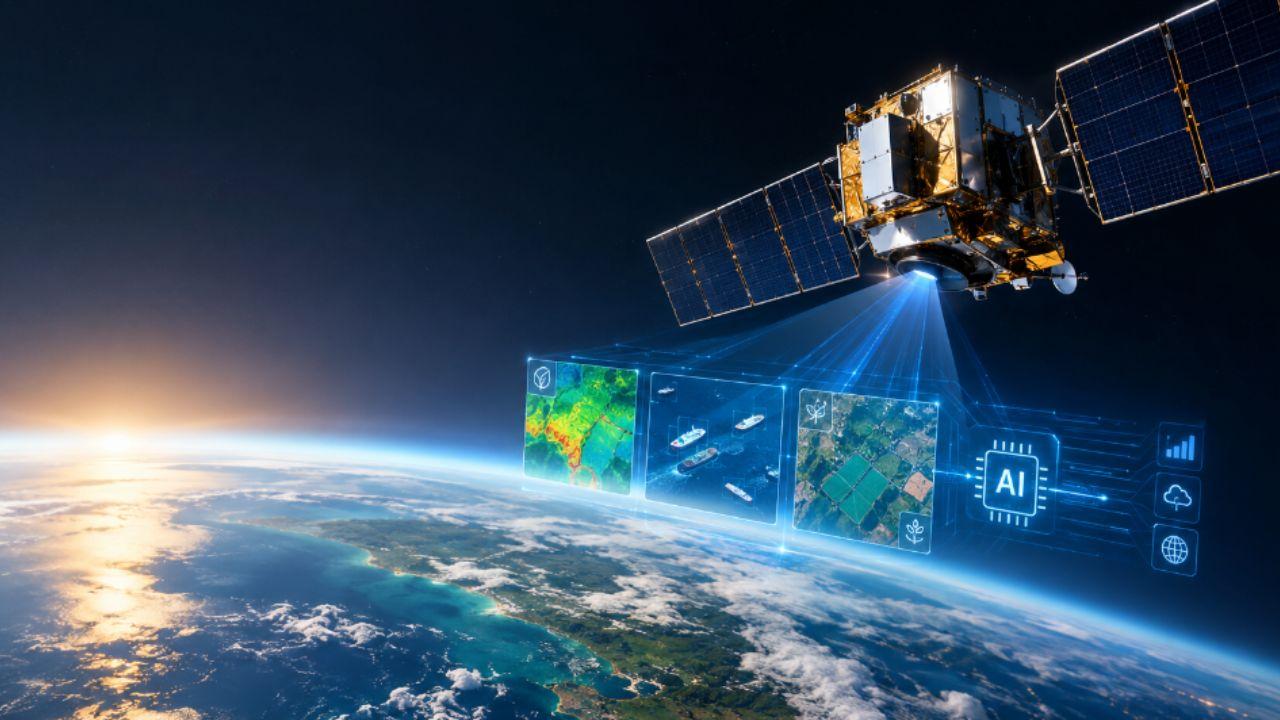
In December, AI entrepreneur Lado Okhotnikov, founder of Holiverse, made a statement that reframed an old idea in a new context: the long-term energy demands of artificial intelligence may eventually push infrastructure beyond Earth, toward space-based solar power.
To understand whether this is a visionary leap or a reaction to mounting pressure, we spoke with experts about where AI’s energy future is really headed, and why space has re-entered the conversation.
Why Space-Based Solar Is Back on the Table

AI has fundamentally reshaped the energy landscape: data centres no longer need incremental increases in capacity – they require vast amounts of power, continuously. Scaling AI on Earth faces hard physical and political limits: renewables depend on sunlight, weather, and grid infrastructure; nuclear power develops slowly; and fossil fuels are increasingly constrained by environmental and political pressures.
A convergence of technical and strategic factors makes space-based solar power a serious topic once again. Aleksandr Doronin of Sinly.ai notes: “With launch costs dropping and space tech maturing, space-based solar is returning as a realistic long-term option rather than pure science fiction.”
This shift from “sci-fi” to a tangible option is driven by falling launch costs, smarter satellites, and explicit plans for large-scale space missions. However, scalability and reliability remain major challenges before SBSP can fully meet the demands of hyperscale AI infrastructure.
Where the System Still Breaks
Despite renewed interest, there is little agreement on where the main technical constraint actually lies. The divergence itself suggests that space-based solar power remains limited by several unresolved layers at once.
From Mikhail Kurlov of Titan’s perspective, orbital construction remains the key limiting factor. "Until we reliably master in-space robotic construction of giant structures," he argues, "the rest of the system can't be fully tested or scaled. It’s not just about launching components — it’s about assembling and maintaining massive platforms in orbit with precision and durability. Without that capability, everything else remains theoretical.”
However, even if large structures can be assembled in orbit, that progress does not automatically resolve what may be the most fragile link in the chain – power transmission back to Earth. "Building things in orbit is hard, but we’re learning fast,” says Mike Shperling from Skygen. “Transmitting huge amounts of power from space – safely, accurately, and without causing interference — that’s still the main headache. You’re dealing with beam precision, atmospheric effects, public safety concerns. That part is far less mature.”
At the same time, the challenge extends beyond engineering. Space-based energy systems would operate in shared orbital and terrestrial environments, where technical feasibility alone is insufficient. Alexander Zvezdin, CEO of Shordex, shifts the focus away from hardware. “The biggest challenge is global-level safety and coordination,” he explains. “We’re talking about high-energy transmission across borders, through regulated airspace, within crowded orbital paths. Debris mitigation, aviation safety, electromagnetic compatibility – none of this can be solved by engineers alone. It requires international agreements, transparency mechanisms, and trust between states. Without that, deployment at scale becomes politically fragile.”
The result is a tightly coupled system with no single point of resolution: advances in construction, transmission, or governance do not eliminate uncertainty in the others, and progress in one domain cannot compensate for stagnation elsewhere.
Reliability: Theory Versus Operations
For AI data centres, reliability is non-negotiable. Even short interruptions can cascade into outages and systemic failures.
In theory, space-based solar offers a compelling advantage. "No night, no clouds," as Shperling puts it. “Orbital arrays don’t face weather variability or atmospheric attenuation in the same way terrestrial renewables do. Conceptually, that makes them attractive for 24/7 workloads that AI demands.”
Yet uninterrupted generation is only part of the equation. Continuous delivery at data-centre scale requires dense and resilient infrastructure – backup pathways, failover mechanisms, beam control redundancy, and tight synchronisation with terrestrial grids. Without that architecture, theoretical uptime does not translate into operational reliability.
Zvezdin agrees that orbital sunlight is far more consistent than terrestrial sources, but cautions against oversimplification. “Consistency of generation doesn’t automatically mean consistency of supply,” he notes. “True reliability would require multiple platforms, overlapping transmission zones, and deep integration with existing grid systems. It’s feasible, but not as a single standalone power source in the near term.”
Complement or Alternative?
On one point, there is broad convergence: space-based solar is not a near-term replacement for Earth-based energy systems. The more pragmatic question is not whether it replaces terrestrial power, but how it integrates alongside it.
“For the next few years – definitely a complement,” says Shperling. He views SBSP as a stabilizing layer for critical systems or regions with weak grid infrastructure, rather than as a full substitute for ground-based generation.
Ambitions of total replacement quickly collide with cost structures, infrastructure demands, and integration complexity. Kurlov is blunt: “Replacing everything on Earth? Probably not. Making AI energy more stable and less constrained – that’s the real objective.”
Where perspectives diverge again is the time horizon. The role of SBSP shifts significantly if industrial activity expands beyond Earth. Zvezdin points to this inflection clearly, arguing that if operations scale to the Moon or Mars, space-based solar becomes less optional and more inevitable – particularly in environments where AI systems substitute for scarce human labour and where terrestrial-style grids do not exist.
Even these longer-term scenarios are framed cautiously. Aleksandr Doronin of Sinly.ai describes the trajectory as evolutionary rather than revolutionary. “In the near future, SBSP is best understood as a complement,” he says. “Over the long term, if launch costs decline and scalability improves, it could evolve into a strategic backbone for AI-era infrastructure – but that’s a gradual transition, not a sudden shift.”
What emerges from this exchange is not a single forecast but a shared restraint: space-based solar is being positioned not as a silver bullet, but as an additional layer – one that may grow in relevance as AI, infrastructure, and off-world expansion develop in parallel.

Never Miss an

Daily updates from the heart of Hollywood, right to your inbox
By entering your email and clicking Sign Up, you’re agreeing to let us send you customized marketing messages about us and our advertising partners. You are also agreeing to our Terms of Service and Privacy Policy.

An Open Question Under Pressure
Space-based solar energy now occupies an uneasy middle ground. It is no longer science fiction – but it is far from a solution.
Okhotnikov’s statement reflects a genuine pressure point rather than a prediction. AI’s growth is forcing energy discussions into uncomfortable territory, where previously excessive ideas are reconsidered simply because they match the scale of the problem.
Whether space-based solar will ever power AI at scale remains unknown. What is clear is that the question itself is no longer theoretical – it is a response to constraints that terrestrial systems are increasingly struggling to absorb.
